
Artificial Intelligence and the structural rethinking of the Intellectual Property system
By Paula Galvan
Intellectual property was born to protect the creations of the human mind. For more than a century, that premise remained undisputed, its very reason for being. But what happens when that intellect begins to expand through systems capable of learning, creating, and deciding? *
It is well known that social and technological phenomena always come first and are regulated later. It is a familiar dynamic, almost natural. But the emergence of artificial intelligence makes it clear that this time, the distance between the law and reality is immense.
The international treaties and national laws that protect intellectual creations were conceived for a world in which creation was manual, linear, and human. Behind every work or invention, there was always a person and a human mind, and the law’s role was to recognize, encourage, and reward that effort. At that time, creativity was inseparable from the human gesture, and intelligence -human intelligence- was regarded as the only engine of innovation.
Today, artificial intelligence composes music, writes screenplays, designs structures, and formulates scientific hypotheses. And it advances at such an exponential pace that we know what we see today is only the beginning. AI has arrived to change everything. Yet, while human intellect becomes increasingly assisted, the law remains anchored in the notion of an individual, isolated, and self-sufficient creator.
In truth, artificial intelligence is merely the latest expression of a long history of tools that expand the capacities of the human mind. It is a tool like many others before it, which were never questioned to this extent: brushes never made the artist, but they allowed the painter to project their vision with greater precision; calculators did not invent mathematics, but they multiplied its reach; and posnets did not create commerce, but made it possible on a larger scale. Likewise, AI amplifies human creativity.
In my view, the problem is not only that the law struggles to keep pace with technology, but that its normative framework no longer describes the reality it seeks to protect. When works are generated with the support o technological tools or through models that learn from the past to produce something new, the very notion of “authorship” becomes blurred. The question, then, is whether norms rooted in the circumstances of the nineteenth century can truly address the dilemmas of the twenty-first.
This article does not aim to analyze the regulation of artificial intelligence exhaustively, nor to propose specific legislative reforms. Its intention is, rather, to observe the phenomenon from the practice of intellectual property: to reflect on what is happening now, how AI is affecting the daily application of the system, and what questions it raises for those of us who work in the law of innovation.
Human authorship as a boundary
The most visible (and probably the most uncomfortable) debate is that of authorship. Can an artificial intelligence system be an author or an inventor? And what happens when creation is hybrid, the product of collaboration between a person and an algorithm? Even further, who owns a work generated without direct human intervention?
This is the world we live in today. Yet, for now, the only clear answers come from the text of existing law: only creations by human beings are eligible for protection. The question that underlies this discussion is whether this limitation is still sufficient to protect what we create, especially considering that many works and all kinds of creative expressions are now conceived or generated with some degree of non-human assistance.
Let’s look at a few real examples, beginning with copyright law in the United States. In 2022, Kristina Kashtanova -an early adopter of AI creative tools- filed to register a comic book titled “Zarya of the Dawn”. The story, written and structured entirely by her, featured images generated with the AI tool Midjourney.
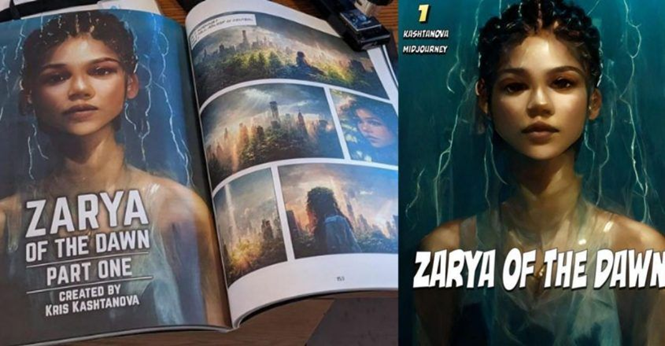
Zarya of the Dawn, written by Kristina Kashtanova and illustrated with Midjourney.
Kristina wrote the prompts, chose the frames, adjusted what she did not like, and assembled each page like a conductor guiding an invisible orchestra. Proud of the result, she filed the work with the U.S. Copyright Office (USCO), naming herself as the author.
Initially, the Office granted registration. But when Kristina publicly explained on social media that the illustrations were generated with AI, the USCO revisited the case and partially revoked its decision. It confirmed that the text, script, and narrative structure were protectable human works, but that the images had to be excluded, as they lacked human authorship.
The baseline was clear: without human involvement, there is no copyright. Just a few weeks later, in March 2023, the USCO published its Copyright Registration Guidance: Works Containing Material Generated by Artificial Intelligence, confirming that only human contributions are registrable. Images generated by algorithms or prompts without direct human control are not protectable. The guidance also clarified that the use of AI does not automatically disqualify a work, but applicants must explicitly declare if -and to what extent- their work includes AI-generated material.
Thus, the U.S. position on copyright is that only human creative contributions can be registered, while any autonomously generated content must be excluded. No rights are recognized over works produced autonomously through AI, not even when there has been meaningful human intervention (an iterative dialogue, successive prompting, or extensive creative curation) to adjust the result generated by the tool.
I must admit, this decision left me thinking. I am certain that Kristina did not obtain a single, perfect, one-click output from Midjourney. She must have had the story in her mind and worked iteratively with the tool: explaining, adjusting, and fine-tuning until she reached the result she envisioned. However, it is also likely that in 2023 (as can be inferred from the USCO’s decision in Kristina’s case) Midjourney’s functionalities regarding user prompts or inputs were still more limited in terms of outputs than those offered today by most AI-driven image generation tools.
I wonder whether these discussions acknowledge that the creative process involving AI is far from a simple “push of a button”. Those who have used these tools know that generating a satisfactory result is not automatic, and rather involves an ongoing exchange between the human mind and the machine: testing, refining, correcting, trying again. In my opinion, creativity still resides in the person who imagines, decides, and guides the outcome. AI does not replace that mind: it amplifies it.
A parallel can be drawn with the use of tools external to the human mind, for example, in the development of an invention. I picture a scientist in her laboratory who, as part of her intellectual work, relies on calculations, algorithms, or reactors to formulate her invention and achieve the result she seeks. In the same way, creators rely on artificial intelligence as a technical means to achieve a creative end. Just as the support used by the inventor does not autonomously produce the development, the AI tool does not generate the work on its own unless it is prompted and guided. In Kristina’s case, isn’t the use of Midjourney analogous to a microscope, one that expands the scientist’s vision and allows her to complete her inventive process?
Let’s look at another example that also invites reflection. The policy of non-recognition reflected in the USCO guidance was reaffirmed by U.S. courts in the well-known case of Dr. Stephen Thaler, a prolific inventor, physicist, and expert in neural networks. Thaler created an AI system called Creativity Machine. In 2018, that system generated an image titled “A Recent Entrance to Paradise”, a hazy, dreamlike vision of an afterlife.
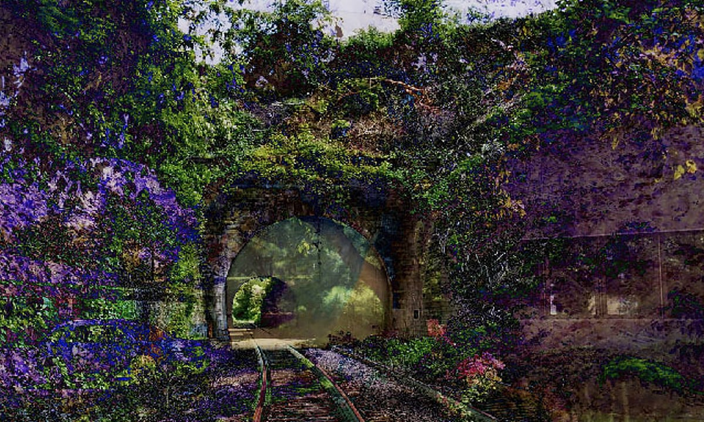
“A Recent Entrance to Paradise”, generated by Creativity Machine.
Thaler submitted the work to the USCO, boldly listing the “author” as Creativity Machine, and naming himself as the owner of the derivative rights, as the tool’s creator. The USCO requested clarification, and Thaler confirmed that there had been no human intervention: the work had been autonomously generated by his AI system.
Naturally, in 2022, the Office rejected the application, explaining that copyright protects works of human authorship, as required by both statute and jurisprudence.
Thaler appealed, both administratively and judicially, arguing that as the creator and owner of the system, he should be recognized as the indirect author, just as the owner of a camera or software tool might be. However, in March 2025, the courts upheld the rejection, maintaining that copyright has always protected works born of the human mind, and that tools may assist but cannot replace the author.
The work thus remained a paradox: it exists, it is art, but it has no author, and therefore no rights. It entered the public domain the moment it came into existence.
Thaler deserves credit for forcing a deeper analysis of these disruptive questions. These were unprecedented cases that needed to be examined. And not content with the copyright rejection, he sought recognition through another legal path: patents.
Inventions and open questions
Thaler also created another AI system, named DABUS (Device for the Autonomous Bootstrapping of Unified Sentience). He claimed that DABUS not only processed data but actually “thought” and “invented new things”.
One day, the system independently designed two inventions:
- A fractal-shaped food container inspired by nature, improving grip and thermal insulation; and
- A flashing emergency light optimized to better attract human attention.
Defiant, and convinced that his creation itself had conceived two inventions, between 2018 and 2019, Thaler filed patent applications in several jurisdictions, listing a single word in the “inventor” field: DABUS. In the “owner” field, he listed himself as the proprietor of DABUS.
The patent offices were uncertain how to proceed: the IA environment was incipient at that time and no one had ever tried to attribute inventorship to a machine. Initially, the responses varied. But eventually, the U.S., U.K., European, German, and Australian offices (the latter two after first-instance rulings favorable to Thaler) aligned: machines have no legally recognizable mind, and only human beings can be inventors.
Thaler insisted that if an autonomous system creates something new, protectable under patent law, recognizing its inventorship was not arbitrary but simply a way of reflecting reality. For the courts, however, the reasoning was far simpler: patent law protects human creative effort. An invention may rely on a tool, but that tool has neither will nor intent, and therefore cannot be the holder of rights.
The U.S. Patent and Trademark Office (USPTO) addressed similar concerns in its 2024 “Guidance on AI-Assisted Inventions”. Its conclusion was pragmatic: AI can participate in the process, but there must be a substantial and identifiable human contribution. In other words, the inventor may use AI as a tool, but cannot fully delegate the conception of the invention. Legally speaking, AI does not “invent”; it assists.
Nevertheless, the DABUS case undeniably reshaped the global debate on intellectual property and artificial intelligence. For the first time, patent offices worldwide had to rule on whether a non-human intelligence could create, and what happens to the rights derived from those creations. Yet despite these efforts, the fundamental question remains unresolved: if the machine proposes a novel technical solution, to whom does the invention belong? The developer of the system? The user who deployed it? The holder of the training data? Who, ultimately, can legitimately exploit and monopolize its benefits?
Most patent laws reaffirm that machines are not -and cannot be- inventors. Unless legislators update that premise, courts will continue to be constrained by the language of the past, even as innovation pushes far beyond it.
AI across other IP rights
Let’s turn now to my favorite area of IP: trademarks. This legal instrument of commercial identity allows consumers to make confident choices in the marketplace, and is the only form of intellectual property that can, in principle, last forever.
Perhaps in Argentina this is not yet fully visible, but AI-driven purchasing decisions, personalized advertising, and predictive sales models are already transforming how brands communicate with consumers. AI shopping assistants, like Amazon’s Alexa, act as intermediaries between consumer and brand, inevitably influencing purchasing decisions. Predictive commerce, where AI anticipates consumer needs and even places orders on their behalf, raises questions of confusion and responsibility. AI can reinforce a sign’s distinctiveness, but also generate new risks of imitation or stylistic mimicry.
AI’s use in brand creation remains largely under the radar. There is no prohibition against generating names, logos, or jingles through AI tools. Algorithms trained on consumer data can even produce catchy tunes optimized for specific geographic or cultural markets. AI is already deeply integrated into marketing and advertising, shaping how consumers perceive brands and make choices.
A similar situation arises in industrial design. AI can analyze aesthetic trends and cultural preferences in particular regions, producing designs that resonate with targeted audiences. This impacts industries like product design, fashion, and architecture, where AI enables the creation of innovative, ergonomic, and market-responsive designs.
In Europe, the 2024–2025 reform package clarifies that a design (even when manifested in non-physical form) may be protected if it was generated with AI assistance, provided there was human intervention in the final selection or configuration, and the design meets the requirements of novelty and individual character. This formula offers a sort of middle ground between human creativity and automation.
In short, artificial intelligence now permeates every branch of intellectual property. It transforms the way we conceive, produce, promote, and consume creativity. Yet more than a replacement, it functions as a new bridge, a layer of mediation between the human mind and the creative outcome.
The challenge for the law is not to redefine each individual right (trademarks, designs, works, or inventions) but to understand that the purpose of the system remains the same: to protect human identity and intention amid automation. In that sense, AI does not dehumanize creation; it compels it to rethink itself.
Where do we go from here?
By now, it is undeniable that the human intellect operates in synergy with AI. Denying protection to works or inventions created with technological assistance (as if the tool negated the creator) seems neither fair nor reasonable.
This article seeks to invite reflection on whether we must revisit the foundational premises of our IP architecture to make it compatible with what we might call “assisted creativity”.
International organizations such as WIPO, through its Conversation on Intellectual Property and Artificial Intelligence, recognize that the current system is in “conceptual tension”, as human intervention is no longer univocal or easily measurable. The AIPPI, in its Study Question on AI and Authorship, has suggested exploring proportional attribution models for AI-assisted works or inventions. Meanwhile, the EPO and EUIPO have jointly emphasized that current frameworks fail to adequately address collective or algorithmic authorship and inventorship, calling for reform.
The intersection between law and artificial intelligence demands more than partial amendments: it calls for a structural rethinking. From my perspective, the key issue is not whether AI can be an author or inventor, but whether a system built for a different century can continue to function without acknowledging that the creative process itself has changed. Creativity is no longer a solitary act but a collaborative network involving humans, algorithms, and vast data sets. Regulating that interaction with rules designed for manuscripts and sketches is, quite simply, utopian.
Yet not everything is uncertainty. AI can also be a powerful ally for legal certainty. At Ojam IP, we are completing the development of a proprietary software that analyzes decisions from trademark offices across Latin America to detect patterns and predict trends in admissibility criteria. Scaled up, this kind of technology could anticipate administrative behavior, reduce arbitrariness, and improve the system’s predictability. In other words, AI can help the law understand itself.
The challenge, ultimately, is not technological but cultural. Artificial intelligence does not replace the human creator: it challenges and assists them. This paradigm shift compels us to ask what we value in creation, whom we recognize as author, and how we distribute the benefits of innovation. The law, for its part, cannot remain a mirror of the past. If human intellect now expands through intelligent systems, its legal protection must expand with it.
The advent of artificial intelligence reminds us that the legal value of creation never resided solely in the author, but in the human capacity to give meaning to the creative act, even when that act is mediated by algorithms. If the law can recognize this new form of co-authorship (between mind, data, and machine) intellectual property will continue fulfilling its essential purpose: to foster innovation and protect what is human within the artificial.
The question is no longer who creates, but how we continue to value creation in a world where thinking is no longer an exclusively human act. The law has always arrived after change, but this time, change is not waiting.
*This article was published in Spanish in the Intellectual Property 4.0 Supplement (No. 1/2026) by Thomson Reuters – La Ley.
For further information please contact paula.galvan@ojamip.com
